
Gray Blending vs. Full Coverage: Which Color Approach Is Actually Right for Your Hair?
Should I Cover My Gray or Blend It In? Here Is What Your Colorist Actually Thinks
Gray blending is a color technique where a colorist works with your natural gray rather than covering it completely, using highlights, lowlights, toning, or root shadow to soften the contrast between gray and pigmented hair. Full coverage uses permanent color to mask gray entirely from root to tip. The difference between them is not just visual. It is a difference in how often you need to come back, how the color behaves as it grows out, and how the hair holds up to repeated color processing over time. Which approach is right depends on how much gray you have, what your natural base color is, and how much maintenance you are realistically willing to commit to.
Why the Conversation Around Gray Hair Color Is Changing
For a long time, the default response to gray hair was to cover it. Full coverage permanent color was the standard recommendation, and most clients accepted the maintenance schedule that came with it without questioning whether it was actually the best approach for their hair.
That is shifting. More clients are coming in specifically asking about gray blending, and the reasons tend to fall into two categories. The first is aesthetic. The fully covered look that was the norm for decades is reading as more dated than it used to, while blended, dimensional gray color has started appearing on women across every age group in a way that makes it look intentional rather than like giving up.
The second reason is practical. A six-week root touch-up schedule is a significant time and financial commitment, and the chemical load of that frequency on the hair accumulates over years. Gray blending changes that equation in ways that are worth understanding before deciding which direction to go.
What Full Gray Coverage Actually Is
How Full Coverage Works
Full gray coverage uses permanent hair color to deposit pigment over the gray strands, making them match the rest of the hair as closely as possible. The color is applied from root to tip or root-focused depending on how much has grown out since the last appointment, and the result is a uniform color that masks the gray entirely.
Because gray hair is resistant to color absorption, full coverage formulas typically require a higher developer and sometimes a longer processing time than color applied to already-pigmented hair. This is one reason why repeated full coverage appointments over years of gray management can lead to noticeable cumulative dryness and porosity changes in the hair.
Full gray coverage uses permanent hair color to deposit pigment over the gray strands, making them match the rest of the hair as closely as possible. The color is applied from root to tip or root-focused depending on how much has grown out since the last appointment, and the result is a uniform color that masks the gray entirely.
Because gray hair is resistant to color absorption, full coverage formulas typically require a higher developer and sometimes a longer processing time than color applied to already-pigmented hair. This is one reason why repeated full coverage appointments over years of gray management can lead to noticeable cumulative dryness and porosity changes in the hair.
Who Full Coverage Is Right For
Full coverage still makes genuine sense for some clients. If you have a small amount of gray concentrated in one area, if the gray came in very early and the rest of your hair is still deeply pigmented, or if you genuinely prefer the uniform look that full coverage produces, it is a reasonable choice. The key is going in with accurate expectations about what the maintenance commitment looks like long term.
It also remains a strong option for clients whose gray is patchy or irregularly distributed in a way that would make blending look uneven rather than intentional. Not every gray pattern blends well, and a colorist who is honest will tell you that directly rather than recommending blending because it is trending.
The Real Maintenance Cost of Full Coverage
Gray grows in at the root. With full coverage, the line between the new gray root and the colored hair is visible and reads as grown-out rather than graduated. Most clients on a full coverage schedule need a root touch-up every four to six weeks to keep that line from becoming noticeable.
Over the course of a year, that is eight to thirteen salon appointments for color alone, not counting cuts, treatments, or other services. The cost adds up quickly, and so does the chemical processing. This is not a reason to avoid full coverage, but it is a reason to know what you are committing to before you start.
What Gray Blending Actually Is
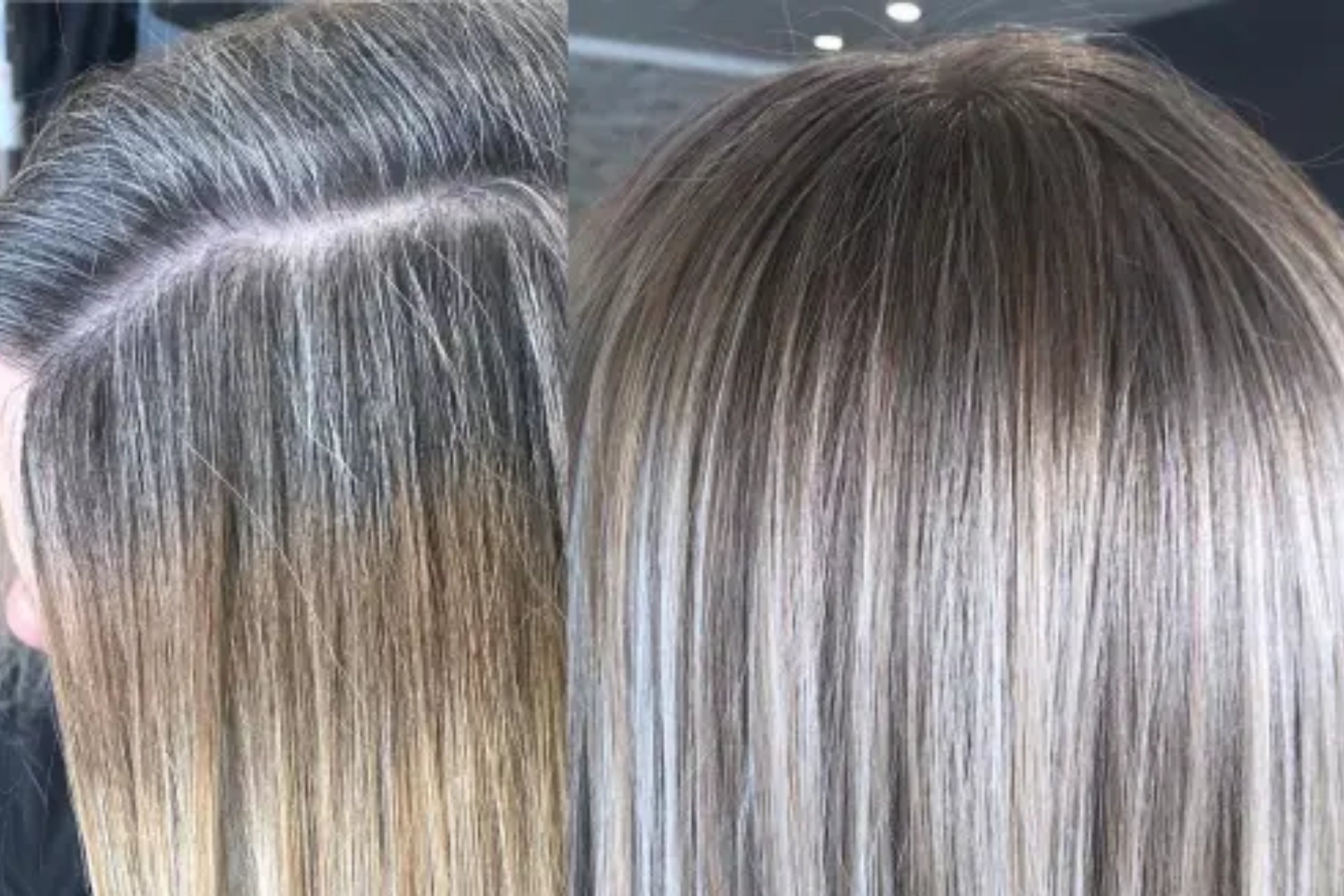
Gray blending does not try to erase the gray. Instead, a colorist uses a combination of techniques to soften the contrast between gray strands and the rest of the hair, creating a result that looks dimensional and intentional rather than simply grown-out or untouched.
The specific techniques used depend on the client's natural base color, how much gray is present, and where it is distributed. Some clients need only a toner or gloss to warm or cool the gray slightly and create cohesion. Others benefit from a root shadow to soften the line at the scalp, highlights to blend the gray into the overall color, or lowlights to add depth that makes the gray read as part of a deliberate color story rather than a separate element.
Why Gray Blending Looks More Natural Than Full Coverage
Natural hair is never one flat color. It has variation, depth, and movement built in, and gray arriving at the root adds another layer of that natural dimension. Full coverage flattens that dimension by making everything the same tone. Gray blending works with it instead.
The result tends to look more like the hair's natural behavior at its best rather than a color treatment applied on top of it. It is also significantly more forgiving as it grows out. Because the gray at the root was never fully covered, there is no hard demarcation line appearing at four weeks telling the world that a color appointment has been missed.
Who Gray Blending Is Right For
Gray blending works best for clients with at least thirty percent gray, because that threshold gives the colorist enough gray to work with in creating dimension rather than just covering isolated strands. It is particularly effective for clients with naturally darker base colors, where the contrast between gray and pigmented hair is highest and benefits the most from softening.
It is also a strong option for clients who are transitioning away from full coverage and want to move toward embracing their gray gradually rather than cutting off all their colored hair at once. Blending can bridge that transition in a way that looks polished rather than in-progress.
The Real Differences Between Gray Blending and Full Coverage
Maintenance Frequency
Full coverage typically requires a return visit every four to six weeks before the root becomes noticeably grown-out. Gray blending, depending on the specific technique used, can extend comfortably to ten to fourteen weeks or longer without the hair looking neglected. That is the most significant practical difference between the two approaches for most clients.
How Each Ages Between Appointments
Full coverage looks best in the weeks immediately after an appointment and progressively more grown-out as the weeks pass. There is no way to disguise a hard root line at week eight on dark hair that has been fully covered.
Gray blending improves as it grows. The softness at the root becomes more integrated over time rather than more obvious, which is the quality that has made it so appealing to clients who found the full coverage cycle exhausting.
How Each Interacts With Your Natural Base Color
Full coverage works against your natural base color by depositing a uniform tone over it. This creates consistency but also eliminates the variation that natural hair has. Over time, repeatedly covered hair can start to look flat and one-dimensional in a way that is difficult to reverse without a lengthy correction process.
Gray blending works with the natural base color by building on what is already there. The gray is incorporated rather than overwritten, which means the result evolves naturally rather than requiring constant maintenance to stay consistent.
Techniques a Colorist Might Use for Gray Blending
Root Shadow or Root Smudge
A root shadow deposits a slightly deeper tone at the scalp that softens the visual line between the gray root and the rest of the color. It does not cover the gray completely but reduces the contrast enough that the grow-out line is significantly less defined. This works well for clients who want minimal intervention with maximum longevity.
Highlights and Lowlights to Blend Gray
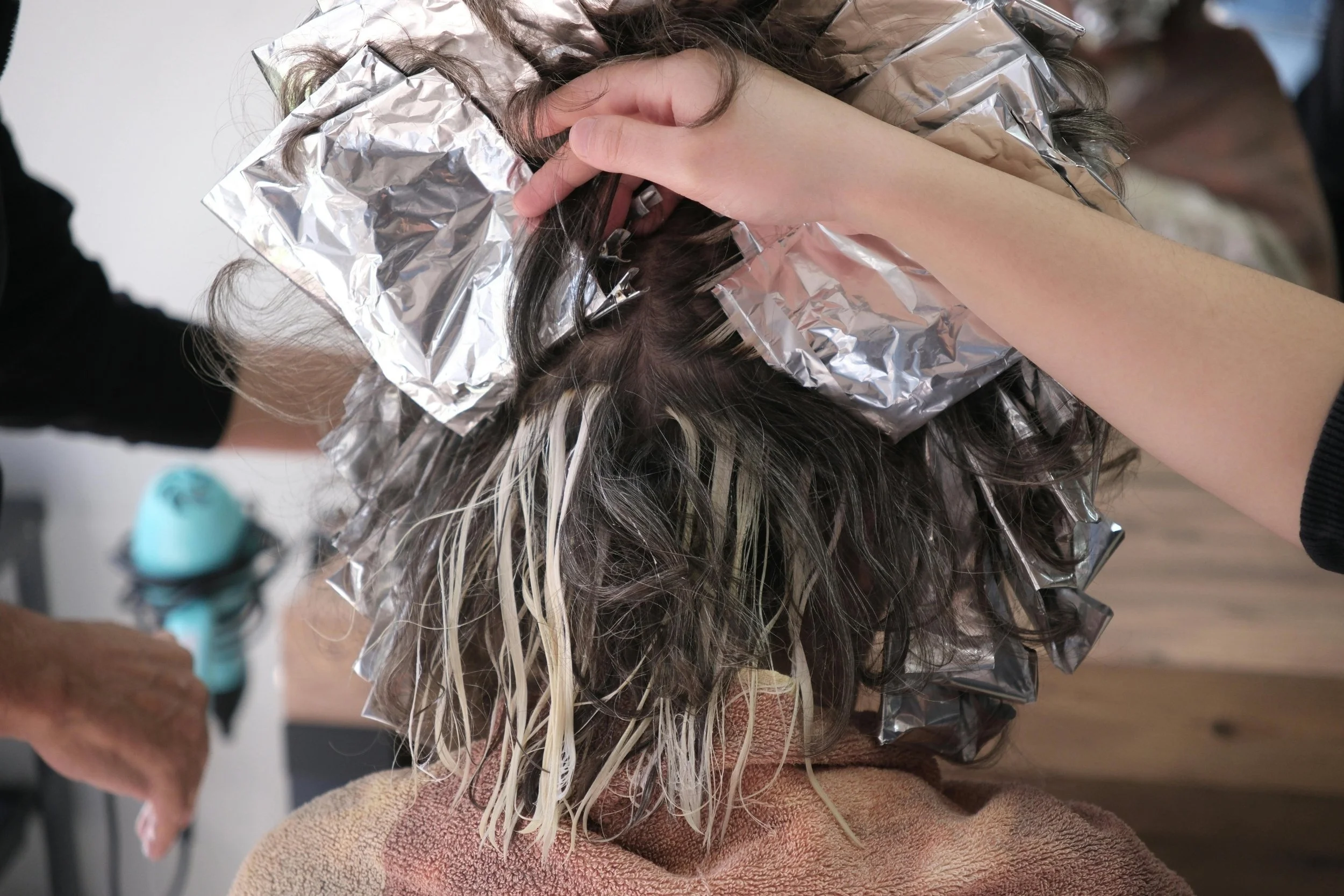
Strategically placed highlights and lowlights can make gray strands read as part of a dimensional, multi-tonal color rather than a separate element. By adding lighter pieces near the gray and slightly darker pieces through the pigmented areas, a colorist creates enough variation that the gray disappears into the overall color story rather than sitting apart from it.
Balayage Into Gray
Balayage applied toward the gray rather than away from it creates a sweep of lighter, blended color that absorbs the gray naturally into the overall look. This is particularly effective for clients with medium to dark brown hair, where the contrast between the base and the gray is the most dramatic. The freehand application of balayage means the blend is customized to exactly where the gray is sitting rather than following a standard formula.
Glossing and Toning
A color gloss or toner applied over the gray does not change its base but adjusts its tone, warming it, cooling it, or adding shine that makes it look more deliberate. For clients with a small amount of gray or gray that has taken on a yellow or brassy cast, a gloss alone can be transformative without requiring any lightening or heavy chemical processing.
What Makes Someone a Good Candidate for Gray Blending
The most important factor is gray percentage. Clients with less than twenty to thirty percent gray typically do not have enough gray for blending to create real dimension. The gray is too sparse to be worked with effectively, and blending techniques may look patchy rather than intentional. Full coverage or highlights that simply blend the few gray strands into the overall color tend to work better at that level.
Above thirty percent, blending becomes significantly more viable and often more flattering than coverage. At fifty percent and above, gray blending tends to produce results that look genuinely striking rather than like a transition in progress.
Gray distribution also matters. Clients whose gray is concentrated at the temples, at the part, or in the front tend to blend beautifully because those areas are the most visible and the most natural-looking places for variation in color to exist. Clients with very irregular or patchy gray distribution may need more discussion with their colorist about whether blending or coverage will produce the more wearable result.
When Full Coverage Still Makes More Sense
Gray blending is not the right answer for every client, and a colorist who recommends it universally without assessing the individual is not giving an honest consultation.
Clients who have strong personal preferences about not having any visible gray, clients who are in professional environments where the appearance of gray carries specific implications they are not ready to navigate, and clients whose gray distribution makes blending technically difficult are all situations where full coverage remains the more appropriate recommendation.
The goal of a good color consultation is never to steer every client toward whatever is trending. It is to understand what a specific person wants their hair to do and then recommend the approach that gets them there most reliably.
What Happens When You Switch From Full Coverage to Gray Blending
This transition is worth discussing specifically because it is not immediate and it requires some planning to do gracefully.
Hair that has been fully covered for years has no gray visible at the shaft. The transition to blending requires either growing out the color gradually, which can look unfinished for an extended period, or using a combination of techniques to create a blended appearance while the fully-covered hair grows through. The second approach is how most colorists handle it, using highlights, lowlights, or a root shadow to create intentional variation that masks the grow-out line during the transition.
The transition typically takes several appointments spread across six to twelve months, depending on how long the hair is and how quickly it grows. Clients who go into that process with realistic expectations and a colorist they trust tend to come out of it with results they genuinely love. Clients who expect an immediate transformation in one appointment are almost always disappointed.
If you have been on a full coverage schedule for a long time and are considering a transition, the most useful first step is a consultation where your colorist can see exactly how much gray you have, where it sits, and what the most realistic path to blending looks like given your specific hair. Rushing the transition is the most common way it goes wrong.
Questions Worth Asking at Your Gray Color Consultation
Before any color decision is made, it is worth asking your colorist what percentage of your hair is currently gray and where it is concentrated. This is information that directly affects whether blending is viable and which technique would work best for your distribution.
Ask what the realistic maintenance schedule looks like for whichever approach is recommended, and ask what the cost difference looks like over a year rather than per appointment. The per-visit cost of blending may be similar to full coverage, but the number of visits required is typically significantly lower, which changes the annual math considerably.
If you are transitioning from full coverage to blending, ask specifically how many appointments the transition will realistically take and what the hair will look like at each stage. Understanding the interim steps before you commit prevents the disappointment that comes from expecting an instant change in what is genuinely a gradual process.
How Denver's Dry Climate Affects Gray Color
Gray hair is structurally different from pigmented hair. It tends to be coarser, drier, and more resistant to color absorption, which is why covering it reliably requires more processing than coloring hair that still has its natural pigment.
In Denver's dry climate, that natural dryness of gray hair is amplified. Gray strands lose moisture faster than pigmented hair in low humidity conditions, which can make the texture difference between gray and colored sections of hair more noticeable between appointments. A color gloss or toner applied over the gray adds a coating that helps it retain moisture and stay looking smooth and intentional rather than dry and wiry.
Overwashing also affects gray color maintenance more than most clients realize. The toner or gloss that gives blended gray its polished quality washes out with every shampoo cycle. Stretching the wash schedule to two or three times a week preserves the tone significantly longer than daily washing does. If the frequency adjustment feels difficult in Denver's summer heat, the guide on overwashing hair in summer covers practical strategies for managing that.

It Is Not About Choosing Gray or Not Choosing It
hat framing is what is shifting. The conversation used to be binary: cover the gray or do not. What gray blending offers is a third option that is more nuanced than either of those positions.
You are not covering the gray, but you are not simply leaving it alone either. You are working with it in a way that gives you control over how it integrates into your overall color without committing to the maintenance cycle that full coverage requires. For a lot of clients, particularly those who have been on a six-week root touch-up schedule for years and are starting to question whether it is worth it, that middle ground is exactly what they were looking for.
Frequently Asked Questions About Gray Blending vs. Full Coverage
What is gray blending hair color?
Gray blending is a color approach where a colorist works with existing gray rather than covering it completely, using techniques like highlights, lowlights, root shadow, balayage, or toning to soften the contrast between gray and pigmented hair. The goal is to make the gray look dimensional and intentional rather than isolated or grown-out. It requires less frequent maintenance than full coverage because there is no hard root line appearing as the hair grows.
How much gray do I need to have for gray blending to work?
Gray blending tends to work best at around thirty percent gray or more. Below that threshold, there may not be enough gray for the technique to create real dimension, and the result can look patchy rather than blended. Above thirty percent, and especially at fifty percent and above, blending becomes significantly more viable and often more flattering than full coverage.
How often do you need to come back for gray blending maintenance?
Depending on the specific techniques used, gray blending appointments are typically needed every ten to fourteen weeks, compared to every four to six weeks for full coverage root touch-ups. This is one of the primary reasons clients choose blending over coverage, since the reduced maintenance frequency translates to fewer appointments per year and less cumulative chemical processing on the hair.
Is gray blending the same as going gray naturally?
No. Going gray naturally means stopping color entirely and allowing the hair to grow out without any intervention. Gray blending is an active color service where a colorist uses specific techniques to manage how the gray integrates with the rest of the color. The result looks far more polished than a simple grow-out and can be adjusted and refined at each appointment to keep the color looking intentional.
Can gray hair be highlighted or have balayage?
Yes, and this is one of the most effective gray blending approaches for clients with medium to dark base colors. Highlights and balayage placed strategically around or near the gray create enough variation in the overall color that the gray strands become part of the dimension rather than a separate element. The freehand application of balayage specifically allows a colorist to customize the blend to exactly where the gray is sitting in your hair.
Will my gray hair turn yellow or brassy?
ray and white hair can develop a yellow or warm cast over time, caused by environmental factors, product buildup, and hard water minerals. This is common and correctable. A color toner or gloss applied over the gray neutralizes the unwanted warmth and restores a cooler, cleaner tone. Purple or blue-tinted shampoos used at home between appointments also help maintain the tone, though they should be used intermittently rather than exclusively to avoid overcorrecting into a dull or purplish cast.
Is gray blending more or less expensive than full coverage?
Individual appointments for gray blending may be similar in cost to full coverage appointments because they still involve professional color services and technique. The meaningful difference is in frequency. Blending clients typically need significantly fewer appointments per year than full coverage clients, which changes the annual cost considerably. Over the course of a year, most gray blending clients spend less in total than clients on a six-week full coverage schedule, while also putting less chemical processing on their hair.
Related Reads
If this got you thinking, these are worth reading next.